It was an unusually foggy and misty morning on Saturday, December 22, 2007. It would not have seemed out of place for Delhi but Chennai’s mist must have put off the crows. So we had no idea what it takes to reach Chennai Central when Sridhar, Adwait and I assembled at platform 2. The MS-Puducheri passenger was ready to depart. We took our seats in the first SLR after the loco but soon gave it up for the holiday crowd and positioned ourselves at the door. Sridhar Joshi immediately took charge of my new Garmin Etrex-H GPS receiver monitoring speeds, acceleration and braking.

The train started on time at 6.35 AM and ran well through the city into the suburbs stopping just at Mambalam, Guindy and Tambaram. At Vandalur, a call to Bharat Moro confirmed that he would not be able to join us at Chengalpattu. The passenger made customary halts at all stations after Tambaram. Adwait noted that he could not feel the pause of the locos transition (series-series to series-parallel) and borrowed the GPS to note the speeds. He was right. The transition did not pronounce itself in the 30 - 40 kmph band. But strangely, it was quite pronounced at around 52 kpmh. The loco’s turbo was screaming wonderfully and the pilot doing a great job of short braking and quick acceleration. We had a max speed of 84 kmph till Chengalpattu.

We reached Chengalpattu a bit late at 8:10 AM just as the Tirumalpur –Chennai Beach EMU glided along us from the Arakkonam line. The Tirumalpur passenger came to a halt on the same platform a few meters short of the WDM7. Sridhar Joshi and Adwait ran fast to collect our tickets to Arakkonam as the passenger was to depart at 8.15 AM. Meanwhile I scouted for something to eat and found some dosas. I settled in the front SLR as usual for the duo to return. A little later, they returned with the tickets. The GPS told me that they walked 6.97 kmph for the tickets. Ironically, the Tirumalpur train took its own time before leaving the tracks vacant for our departure. We polished off the indifferent dosas and some vadas from another vendor. Sridhar meanwhile wanted to attend the world’s oldest call but all the toilets of the train were locked up for some reason. We wondered what was the difference between a passenger and a MEMU without toilets.

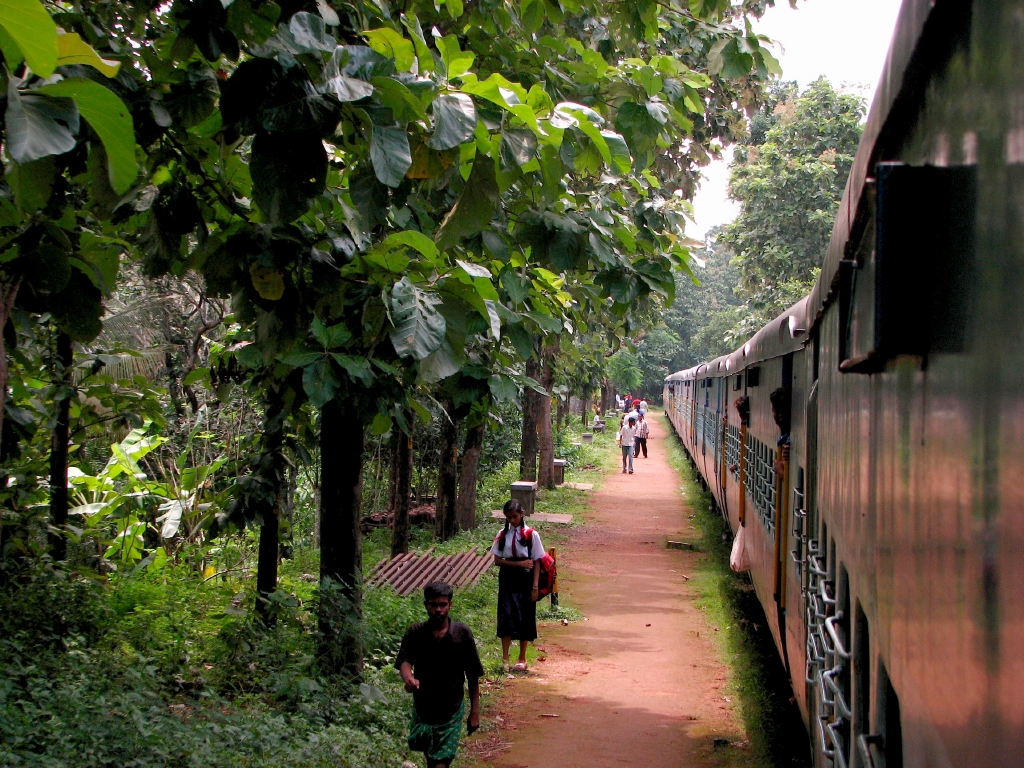
The EMU delayed us by 15 minutes and we started at 8:30 AM. The train was partly filled. We had three seats for ourselves that we were soon going to abandon as usual. The train went on the mixed gauge tracks for a short distance and diverted itself onto the Arakkonam line. The MG tracks were still in place despite the services being stopped. As the train negotiated a cautioned zone with sandbagged embankments, Sridhar shot off the latest land prices in the area further demotivating me from the idea of owning a property in Chennai. Soon the train picked up speed, as we rolled along a pleasant and green countryside rich from the benefits of the recent rainfall.

The WDM7’s flat drum beat kept us company. The loco did not seem to have any transition suggesting a complete series connected motors. Like the WDM3D driver, this one’s pilot was as adventurous with braking and accelerating. After Reddipalayam and Villiambakkam, we stopped at Palur made famous by the National Geographic video report on steam locomotion in India. Palur was not the same anymore as we saw it on the report. The transformation was complete with electric catenaries and modern high platforms and amenities. Once upon a time this was a backwater branch line but now the flurry of modern constructions along the line depicted a different picture now. Even the electric catenary masts spoke of modernization. Most of them consisted of pre-cast concrete poles rather than the regular steel ones.
Post Palur, the scenic beauty remained with the addition of large water bodies enabled by the copious rainfall in the region recently. We had the only crossing at Walajahbad where the Tirupati – Puducheri passenger awaited us to clear the line. The entire route was a token less territory robbing us of the scene of token exchange.
Post Palur, the scenic beauty remained with the addition of large water bodies enabled by the copious rainfall in the region recently. We had the only crossing at Walajahbad where the Tirupati – Puducheri passenger awaited us to clear the line. The entire route was a token less territory robbing us of the scene of token exchange.

A sudden appearance of modern buildings announced Kanchipuram. After Kanchipuram (Old), we entered the modern and clean Kanchipuram station with just one platform. The road connecting the town with the Bangalore highway was just next to the station and teemed of a large number of vehicles. The gopuram of Varadaraja Perumal temple loomed large in the background with the spires of two other temples close by. One of the wonderful aspects of this lovely line was the abundance of curves.


Post Kanchipuram, the train forever seemed to hit one curve after the other. As a bonus, we were rewarded with the Arakkonam road, a neat and superb affair, extremely close to the tracks. The road ran along with us all the way to Arakkonam. Little towns and villages along the road came and went as we rolled. Tirumalpur was a bigger station with two platforms and other amenities. The Tirumalpur EMU terminated here but the electrification continued further up the line and stopped abruptly just outside Takkkolam.

INS Rajali loomed large along the line as we entered Arakkonam. I had hoped for a glimpse of the TU-154 “Bear” but could see any planes. There are two different platforms at Arakkonam for this line. The first one was just ahead of the mainline station and the train was almost perpendicular to the platforms there. It was just a platform without anything else and quite dirty. But most of the passengers chose to detrain here. The second platform (island) is beyond the mainline station in a corner and our train had to negotiate a steep curve to enter it. We had arrived on time at 9.50 AM despite a late start. The maximum permissible speed of the route was 90kmph and our GPS showed a max speed of 82 kmph. With no trains ahead of us and only one crossing, this train did not make any unscheduled halts enroute.
We got off the train and trekked a long way to the ticket counter on the opposite side. We had to pass all the platforms of Arakkonam and two foot over bridges. There was a huge crowd on the second foot over bridge that took us to the ticketing office. This was the regular commuter crowd to Chennai that was not sure which platform would the next EMU from Tirutani would arrive. So like cats on the wall they hung about on the overbridge. At the ticket counter we quizzed the man on the rates to Renigunta and Gudur and finally bought an express ticket all the way to Gudur via Renigunta. The man was perplexed b our choice as he felt it was much better to reach Gudur via Chennai. We had to explain our motive to him before we went out for a refreshing cup of tea and smoke. We returned and settled down in the waiting hall of platform 2 and 3 and observed the traffic. Our next train to Renigunta, the 1041 Chennai- Mumbai Mail was at 12:40 PM. But as the clock struck 1.00 PM, we were still waiting for the train to arrive.
Finally at 13:12 hrs, the 1041 came in 32 minutes late. The front SLR was for ladies though a few men oblivious to the fact were perched on the seats within. We took the next General coach by the door. We perched our bottoms on the doorway with Sridhar at the doorplate and enjoyed the fast and smooth run to Renigunta.
This line was cleared for 110 kmph and we hit MPS quite quickly thanks to the excellent performance of the WAM4 ahead. It was one exhilarating run akin to a roller coaster as the train negotiated numerous curves without a hint of slowing down. At Tirutanni, I moved to the other doorway and perched on my backside dangling my legs out. The train was close to the MPS all the time and the wonderful scenery outside added to my excitement. Soon the tall peaks of the Eastern Ghats appeared with smaller hills pock marked with big boulders. The valleys below were swathed in green and the sun was just about the right temperature. At Ponpadi, the opposite line disappeared as we hit one huge S curve and rolled on. We had deviated widely from the other line and only joined it at Nagari within AP. Puttur came and went and once again the tracks played hide and seek with each other. A big pool of water parted us after Taduku to be rejoined again at the next station. I spotted a hill range with a huge peak of rock that resembled a WDM2 hauling a passenger rake. It was a treat of sorts all the while till now as the adventurous braking and accelerating continued on this train as well. The rake oscillated madly to the speeds. Later as the hide and seek of the up and down tracks continued, just before Pudi, I spotted the 1042 disappearing into the foliage far away as it negotiated a curve away from us. Had it not been for the red ailway mail service coach amongst the blue passenger coaches, I would still be guessing which train was it. We hit Renigunta at 14:20 hrs, 20 minutes ahead of time despite being 32 minutes late at AJJ. Slack time worked well here. The extra time will be useful in the loco change. Sridhar went up to the loco pilot and showed him the max speed on the GPS and commended him on the acceleration and braking.
Hotel Ruchi promised us Maharastrian meals in pure Marathi just outside Renigunta station. But we went ahead to another restaurant that promised us north, south and Maharashtrian meals. We opted for the Maharastrian meals here and found out what Henry Ford meant when he said “It can be of any colour as long as it is black” referring to the Model-T. The meals were all South Indian except for a couple of rotis to differentiate it as Maharastrian. We finished off the insipid meal and returned back to the station to catch the Guntur passenger to Gudur.
We were again rewarded with an excellent acceleration and braking. The line from Renigunta to Gudur was well maintained with fresh ballasting and minimum oscillations. The route had an MPS of 105 KMPH and we were steady in the 90-100 kpmh band. The Max Speed we hit was 101 kpmh, quite impressive for a passenger. The scenery outside was quite different from the usual Rayalaseema terrain with a lot of greenery and plenty of water bodies. All the stations had platforms at door level and modern amenities. We were on time at all stations but had to be held up just outside Gudur to let a mainline freight and another passenger towards Tirupati pass. We hit Gudur at 17:40 exactly as the loco pilot of the train had predicted…about 5 minutes late. Bidding a goodbye to yet another wonderful train, we stepped out for some coffee. We spied a dosa outlet where I gorged into some dosas before we had some muddy dark coffee. We returned to the station for our last leg. This time, we had a proper reservation in the D5 coach of none other than the BZA-MAS Jan Shatabdi Express. We had traveled on three passengers and an Express and now about to do a superfast. What a day! I was looking forward to the last leg of ultimate speed and acceleration. But the train was a good hour late according to the officials. We had to walk to the end of the platform to avoid the mulling crowd that was waiting for the Nellore – Chennai MEMU (Mainline Electric Multiple Unit). Since we had reserved tickets, we did not want to board the MEMU else we would have added another kind of train for out trip. In any case, the Chengalpattu-Arakkonam passenger with locked toilets earlier was akin to the Diesel Electric MU with matching acceleration and braking.
GDR railway station is renowned for one thing. Mosquitoes of humongous size. We had spied an empty bench and sat on it and soon, I gave up the fight and chose to be mutilated by the mozzies. We were all tired and Sridhar and Adwait had decided to doze off on the JS.
The MEMU came and went as I dozed off. A little later I woke up to the sound of a single tone horn and spied a WAP4 like beast in the darkness on the far away freight loops hauling a BCNA rake slowly. As the light fell on the loco we saw the number 31122! A green loco with a yellow band. It was my first ever sighting of a WAG 9 in a proper manner! The silent beast rolled lazily to the starter and waited there for a while before moving towards Renigunta. The WAG 9 hauled BCNA will ensure that the Express stays for a while at GDR.
Sridhar finally spotted our train far away at 19:27 just as the Tirupati-Secundearbad Padmavathi Express arrived . 3 minutes later we found the JS on the first platform and to our dismay, found a Kazipet WAG 7 freight locomotive at its head. I was beginning to feel that the anticipated superfast experience was about to die there and then! We soon found ourselves in our seats in D5 as the train rolled. We settled down, had some samosas and some diluted tea and relaxed. I closed my eyes for a while. Sridhar meanwhile restarted the GPS to note the speeds. The train was not moving at a great speed and was restricted to the 80kmph band on a track suitable for 105 kpmh.
Old habits die hard! Like Pavlov’s dog, Sridhar and Adwait soon felt the urge to doorplate and promptly broke their self imposed rule of rest and sleep and abandoned their reserved seats for the door. This was also probably prompted by the catering staff’s inability to produce Sridhar’s favourite omelettes. Since the two were firm on door plating, I had no other choice and joined them at the door to record one of the worst runs of JS in my memory! The WAG 7 was finding it difficult to accelerate! We were hardly touching 95 kmph and the series of caution orders ensured a quick deceleration followed by a slow acceleration that took forever. The GPS told me how painful the loco felt in the 50kmph and the 70kpmh bands as it struggled to move to the next band. The 80;s band was quick but the loco took its own time to reach 95 kmph from 90 kmph. At Elavur, we were thrown into the loop line at 15 kmph restriction thanks to a freight parked on the mainline. After the exhilarating Renigunta-Gudur run on a lowly passenger, we had to endure a shameful run on the Gudur - Chennai section on a super fast ! After Minjur, the train somehow redeemed itself with a max speed record of 100 kpmh, one short of the passenger earlier.
After Ennore the train slowed down further and crawled for a while at 30 kmph before picking speed up to 60 kmph at Tondiarpet only to decelerate again at Korukkupet and thereafter crawl all the way to Platform 5 at 10:30 PM. For consolation, the train was not parked behind the Bangalore Shatabdi as usual, which would have meant we had to walk a long way to the exit. We walked out of the station to the auto stand. Sridhar was supposed to catch an EMU to Perambur while Adwait and I had to get back to Egmore, our starting point to collect our respective vehicles. That was where we encountered the auto fares of Rs 13 per kilometer and the start of this report!
Consider this: It cost Rs 17 per head between MS and CGL. Rs 17 again between CGL and AJJ. Rs 48 between AJJ and GDR via RU and rs 75 between GDR and MAS.
The numbers stack up as:
1. MS- AJJ 118 km Rs 34 84 km max speed Scenic
2. AJJ-RU-GDR 158 km Rs 48 110kmph/101 kmph Speed and scenic
3. GDR-MAS 138 km Rs 75 100 kmph Late, slow, dark
Ironically, we had the best part of our journey in terms of running experience and scenic value at 30 paisa per kilometer sitting by the door in a crowded coach ( AJJ-RU and RU-GDR); while the worst part of the journey was at 45 paisa per kilometer in cushioned chairs of a reserved coach of a super fast with catering service. At 29 paisa per kilometer the MS-AJJ run was the cheapest, slowest and most timely run.
So it took us 16 hours and 414 km of travel on five trains through two railway zones and two states to reach Chennai Central from Chennai Egmore which lay 3 km from each other as a crow flies. But that day, the crows did not fly!
We got off the train and trekked a long way to the ticket counter on the opposite side. We had to pass all the platforms of Arakkonam and two foot over bridges. There was a huge crowd on the second foot over bridge that took us to the ticketing office. This was the regular commuter crowd to Chennai that was not sure which platform would the next EMU from Tirutani would arrive. So like cats on the wall they hung about on the overbridge. At the ticket counter we quizzed the man on the rates to Renigunta and Gudur and finally bought an express ticket all the way to Gudur via Renigunta. The man was perplexed b our choice as he felt it was much better to reach Gudur via Chennai. We had to explain our motive to him before we went out for a refreshing cup of tea and smoke. We returned and settled down in the waiting hall of platform 2 and 3 and observed the traffic. Our next train to Renigunta, the 1041 Chennai- Mumbai Mail was at 12:40 PM. But as the clock struck 1.00 PM, we were still waiting for the train to arrive.
Finally at 13:12 hrs, the 1041 came in 32 minutes late. The front SLR was for ladies though a few men oblivious to the fact were perched on the seats within. We took the next General coach by the door. We perched our bottoms on the doorway with Sridhar at the doorplate and enjoyed the fast and smooth run to Renigunta.
This line was cleared for 110 kmph and we hit MPS quite quickly thanks to the excellent performance of the WAM4 ahead. It was one exhilarating run akin to a roller coaster as the train negotiated numerous curves without a hint of slowing down. At Tirutanni, I moved to the other doorway and perched on my backside dangling my legs out. The train was close to the MPS all the time and the wonderful scenery outside added to my excitement. Soon the tall peaks of the Eastern Ghats appeared with smaller hills pock marked with big boulders. The valleys below were swathed in green and the sun was just about the right temperature. At Ponpadi, the opposite line disappeared as we hit one huge S curve and rolled on. We had deviated widely from the other line and only joined it at Nagari within AP. Puttur came and went and once again the tracks played hide and seek with each other. A big pool of water parted us after Taduku to be rejoined again at the next station. I spotted a hill range with a huge peak of rock that resembled a WDM2 hauling a passenger rake. It was a treat of sorts all the while till now as the adventurous braking and accelerating continued on this train as well. The rake oscillated madly to the speeds. Later as the hide and seek of the up and down tracks continued, just before Pudi, I spotted the 1042 disappearing into the foliage far away as it negotiated a curve away from us. Had it not been for the red ailway mail service coach amongst the blue passenger coaches, I would still be guessing which train was it. We hit Renigunta at 14:20 hrs, 20 minutes ahead of time despite being 32 minutes late at AJJ. Slack time worked well here. The extra time will be useful in the loco change. Sridhar went up to the loco pilot and showed him the max speed on the GPS and commended him on the acceleration and braking.
Hotel Ruchi promised us Maharastrian meals in pure Marathi just outside Renigunta station. But we went ahead to another restaurant that promised us north, south and Maharashtrian meals. We opted for the Maharastrian meals here and found out what Henry Ford meant when he said “It can be of any colour as long as it is black” referring to the Model-T. The meals were all South Indian except for a couple of rotis to differentiate it as Maharastrian. We finished off the insipid meal and returned back to the station to catch the Guntur passenger to Gudur.
We were again rewarded with an excellent acceleration and braking. The line from Renigunta to Gudur was well maintained with fresh ballasting and minimum oscillations. The route had an MPS of 105 KMPH and we were steady in the 90-100 kpmh band. The Max Speed we hit was 101 kpmh, quite impressive for a passenger. The scenery outside was quite different from the usual Rayalaseema terrain with a lot of greenery and plenty of water bodies. All the stations had platforms at door level and modern amenities. We were on time at all stations but had to be held up just outside Gudur to let a mainline freight and another passenger towards Tirupati pass. We hit Gudur at 17:40 exactly as the loco pilot of the train had predicted…about 5 minutes late. Bidding a goodbye to yet another wonderful train, we stepped out for some coffee. We spied a dosa outlet where I gorged into some dosas before we had some muddy dark coffee. We returned to the station for our last leg. This time, we had a proper reservation in the D5 coach of none other than the BZA-MAS Jan Shatabdi Express. We had traveled on three passengers and an Express and now about to do a superfast. What a day! I was looking forward to the last leg of ultimate speed and acceleration. But the train was a good hour late according to the officials. We had to walk to the end of the platform to avoid the mulling crowd that was waiting for the Nellore – Chennai MEMU (Mainline Electric Multiple Unit). Since we had reserved tickets, we did not want to board the MEMU else we would have added another kind of train for out trip. In any case, the Chengalpattu-Arakkonam passenger with locked toilets earlier was akin to the Diesel Electric MU with matching acceleration and braking.
GDR railway station is renowned for one thing. Mosquitoes of humongous size. We had spied an empty bench and sat on it and soon, I gave up the fight and chose to be mutilated by the mozzies. We were all tired and Sridhar and Adwait had decided to doze off on the JS.
The MEMU came and went as I dozed off. A little later I woke up to the sound of a single tone horn and spied a WAP4 like beast in the darkness on the far away freight loops hauling a BCNA rake slowly. As the light fell on the loco we saw the number 31122! A green loco with a yellow band. It was my first ever sighting of a WAG 9 in a proper manner! The silent beast rolled lazily to the starter and waited there for a while before moving towards Renigunta. The WAG 9 hauled BCNA will ensure that the Express stays for a while at GDR.
Sridhar finally spotted our train far away at 19:27 just as the Tirupati-Secundearbad Padmavathi Express arrived . 3 minutes later we found the JS on the first platform and to our dismay, found a Kazipet WAG 7 freight locomotive at its head. I was beginning to feel that the anticipated superfast experience was about to die there and then! We soon found ourselves in our seats in D5 as the train rolled. We settled down, had some samosas and some diluted tea and relaxed. I closed my eyes for a while. Sridhar meanwhile restarted the GPS to note the speeds. The train was not moving at a great speed and was restricted to the 80kmph band on a track suitable for 105 kpmh.
Old habits die hard! Like Pavlov’s dog, Sridhar and Adwait soon felt the urge to doorplate and promptly broke their self imposed rule of rest and sleep and abandoned their reserved seats for the door. This was also probably prompted by the catering staff’s inability to produce Sridhar’s favourite omelettes. Since the two were firm on door plating, I had no other choice and joined them at the door to record one of the worst runs of JS in my memory! The WAG 7 was finding it difficult to accelerate! We were hardly touching 95 kmph and the series of caution orders ensured a quick deceleration followed by a slow acceleration that took forever. The GPS told me how painful the loco felt in the 50kmph and the 70kpmh bands as it struggled to move to the next band. The 80;s band was quick but the loco took its own time to reach 95 kmph from 90 kmph. At Elavur, we were thrown into the loop line at 15 kmph restriction thanks to a freight parked on the mainline. After the exhilarating Renigunta-Gudur run on a lowly passenger, we had to endure a shameful run on the Gudur - Chennai section on a super fast ! After Minjur, the train somehow redeemed itself with a max speed record of 100 kpmh, one short of the passenger earlier.
After Ennore the train slowed down further and crawled for a while at 30 kmph before picking speed up to 60 kmph at Tondiarpet only to decelerate again at Korukkupet and thereafter crawl all the way to Platform 5 at 10:30 PM. For consolation, the train was not parked behind the Bangalore Shatabdi as usual, which would have meant we had to walk a long way to the exit. We walked out of the station to the auto stand. Sridhar was supposed to catch an EMU to Perambur while Adwait and I had to get back to Egmore, our starting point to collect our respective vehicles. That was where we encountered the auto fares of Rs 13 per kilometer and the start of this report!
Consider this: It cost Rs 17 per head between MS and CGL. Rs 17 again between CGL and AJJ. Rs 48 between AJJ and GDR via RU and rs 75 between GDR and MAS.
The numbers stack up as:
1. MS- AJJ 118 km Rs 34 84 km max speed Scenic
2. AJJ-RU-GDR 158 km Rs 48 110kmph/101 kmph Speed and scenic
3. GDR-MAS 138 km Rs 75 100 kmph Late, slow, dark
Ironically, we had the best part of our journey in terms of running experience and scenic value at 30 paisa per kilometer sitting by the door in a crowded coach ( AJJ-RU and RU-GDR); while the worst part of the journey was at 45 paisa per kilometer in cushioned chairs of a reserved coach of a super fast with catering service. At 29 paisa per kilometer the MS-AJJ run was the cheapest, slowest and most timely run.
So it took us 16 hours and 414 km of travel on five trains through two railway zones and two states to reach Chennai Central from Chennai Egmore which lay 3 km from each other as a crow flies. But that day, the crows did not fly!